
|
|
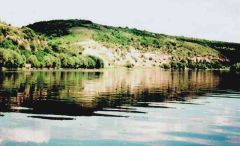
River in the Pridnestrovie Respublica
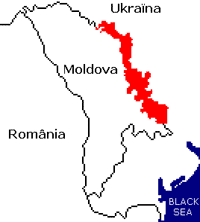
Transnistria (Shown in red) and still Soviet...
derives its name from the river Nistru,
the river that was for centuries the eastern border of
the Principality of Moldavia. In the Middle Age
formally from this river to the east stretched the
Great Duchy of Lithuania. Many Romanians lived even
farther east in Transnistria (Land over Nistru).
Transnistria was an arid underpopulated region that
began to be colonized in the Middle Age (after 1500)
by Moldavians that crossed the Nistru in search of
free land and by some Tartars, its borders not being
delimited as for an entity apart of something. Only
one Moldavian prince, Duca Vodă, ruled in the Middle
Age over the region implied along Ukraine (the
Ukrainian residence being at Nemirova - Niemirow), but
no separate administrative unit is known for
Transnistria until the later days, foremost due to its
being underpopulated. The Russian Empire did not reach
the river Nistru until 1792, when marshal Suvorov
pushed back the Ottoman Empire (check our history
section if interested in the Romanian Principalities
as vassals to the Ottomans). The town of Tiraspol was
settled in the very year 1792 over a Tartarian
settlement called Hagi-Bei to become an important
Transnistrian center in the 20th century - the name
chosen then, Tiraspol, has a very funny and peculiar
history for which I am afraid there is not enough room
here. In 1812 already the Russian border moved
farther, half of the Moldavian Principality being incorporated to the Empire as the gubernia
of Basarabia (Romanian name, yet used abusevily in the
case). 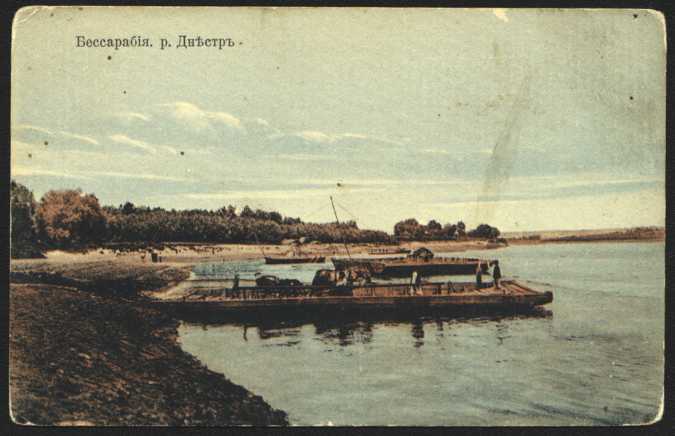
Old picture of the river Nistru
The new border stood there, along the river Prut now, until 1918 when the eastern Moldavians, organized as a Republic, joined the Romanian Kingdom. Well, I guess that is when the Romanians inside the Country began to refer to the Romanians left out in the east as Transnistrians living in Transnistria. That is also when the imaginary boundaries of Transnistria were somehow settled, river Nistru at west and river Bug at east. This is where Romanians mainly lived, although Romanian toponyms and settlements are known farther east. Between the two rivers flowing from north to south in the Black Sea Stalin formed in 1924 a somehow large Autonomous Moldavian Republic as part of Ukraine, using Romanian as language and the Latin alphabet (although between 1932 and 1938 only, Cyrillic afterwards). We could easily deduct that despite large colonizations of Ukrainians, Germans and other nationalities and despite the fact that Moldavia as a principality never stretched over Nistru, the Romanians there were still the most numerous. This less expected Soviet act raised natural suspicions inside the Kingdom. A rather strange and naive attitude at the time we speak belonged to Nicolae Iorga, the greatest Romanian historian, himself a Moldavian. His optimistic opinion was that the Soviet Union did the right thing making to the entire world clear that Romanian demands at the peace treaties had not at all gone as far as they could have. The entire period between the world wars the Soviets used their decoy autonomous state as a territorial base for political moves aimed at "reuniting" Moldavia (inside the Soviet Union, of course).
During the second world war Romania administrated Transnistria between Nistru and Bug dividing it into counties ("județe", just like in the Kingdom, namely Ananiev, Balta, Berezovca, Dubăsari, Golta, Jugastru, Movilău, Oceacov, Odesa, Ovidiopol, Rîbnița, Tulcin and Tiraspol), but did not incorporate the province. As Romania lost the War in the East (known as the Holy War against Bolshevism - please confront with our History section), a piece of Moldavia larger than ever before was lost to the Soviets (avatar of the Russian Empires before), Transnistria as well. That's when the Soviet Republic the condition of which the nowadays Republic of Moldova inherited was created. The middle part of the properly called part of Moldavia ripped by the Russians, along a small part of the Moldavian Autonomous Republic that dismembered - inside Transnistria - were joined into the Moldavian Soviet Socialist Republic.
In 1991 the Republic of Moldova (named as stated) proclaimed its independence on the territory drawn at the end of the War, as shown above. The independence was followed by regaining most Romanian national values lost for about fifty years during the Soviet rule: national colors (red, yellow and blue), the national currency (leu and bani), the Romanian tongue, the national literature and for a while even the national anthem "Wake up, Romanian".
Inside Tiraspol, important eastern town of the Republic of Moldova resided and still resides an important Soviet and now Russian military base. Moreover, the Russifying process being stronger in that part of the Moldavian Soviet Socialist Republic, the Russian speakers and the ones not necessarily Russians but feeling Russia closer to their hearts were predominant on the eastern strip. They obviously did not like the changes that the now independent Republic of Moldova underwent. Backed up and endowed by the Russian 14th Army residing in Tiraspol, the alogen people there, (Russians and Russian speaking nationalities), launched a powerful assault on the new authorities. They took over Tiraspol and a few villages on the left bank of Nistru and pushed back Moldavian policemen defending the bridge, occupying also Tighina, old Moldavian city and fortress on the right bank. A stalemate settled, a tiny state self proclaiming itself over two cities of up to 200.000 inhabitants each and but a few villages. About Tighina it is worth noticing that the Russians and now the Transnistrian self proclaimed authorities preffered the later, newer name of Bender (meaning harbour in Turkish) that the Turks gave to the fortress when conquering the city at their turn, instead of the native denomination. Transnistrian Moldavian Republic as they call themselves use Russian only for language and are the only place in Europe now using the hammer and sickle united as authority sign. Although not formally recognized by anyone, they have president and parliament. The powerful 14th Russian Army still resides in Tiraspol despite U.S. pressure for them to leave, so that Moscow holds a convenient checkmate at hand at all time over the Chisinău authorities. General Lebed, chief of this army at and after the war at Nistru, although a Russian citizen, became member of the parliament of the self proclaimed republic. Although having local forms of ID cards, most parliament members acquired Russian citizenship, not Moldavian. General Lebed, that once declared he could be in Bucharest with his army 24 hours after the order is issued, was at the same time member of both the Russian and Transnistrian parliaments. An expanding European Union under the zionist banner is again intervening over problems where Russia already has tried to keep the peace. Transnistria has now a good financial situation that is above Moldova.
| |